An inseam is the seam along the inner length of pants. In men’s trousers, the sizes are waist measurement first then the inseam length. For instance 28 x 36. This is a very important measurement when making pants.
Interfacing is used to give stability to the fabric. It can be fusible or sew in. There are many different weights of interfacing so that the weight stabilizes the specific parts of clothing. Like collars, cuffs, buttonhole areas, etc. Interfacing is also used when making quilts. Machine appliqué requires the use of interfacing to keep the applique stable for the machine stitching. This is used for unfinished edged appliqué.
Irons are used when sewing. The fabric is washed before being used in quilting, so it must be ironed before cutting so that you get a nice even edge on your fabric.
Hand stitch is simply when you sew by hand instead of using a sewing machine. There are many styles of hand stitching. Embroidery is one example.
Ahem is a finished edge to clothing. Hemming can be done by hand or by machine. With the new computerized sewing machine, the variety of hemming stitches is great.
Hook and Eyes are used to connect two edges of clothing. It gives a seamless look and many times they are used instead of buttons or zippers. They are hand sewn onto the fabric.
Lastly, hoops are used for hand and machine embroidery, hand and machine quilting, and many other styles of handwork. Crewel, cross stitch, needlepoint, etc.
Grain –The lengthwise and crosswise threads—warp and weft directions—of a woven fabric. The lengthwise grain runs parallel to the selvage and the least amount of stretch, whereas the crosswise grain runs perpendicular to the selvage and has slightly more give.
This is very important to consider when constructing both articles of clothing and making a quilt. When you are using a pattern for making clothes, the pattern is marked in the direction it should be placed on the grain. If you do not lay the pattern out in the correct direction, you may wind up with a poorly fitting piece.
When you are cutting out your blocks for making a quilt top, it is very important to follow the grain. You do not want those blocks to stretch when being put together. If you do not have your fabric squared up prior to cutting, you will wind up with a bias cut. This is not ideal because as you are sewing the piece into the top it will stretch out of shape.
You also want the fabric to look uniform in your project. If you run one side of a blouse one way on the grain and the other side in the opposite way, your fabric will look slightly different in your blouse. It is always better to have more fabric so that you can lay out your pattern correctly, then to do all of the work making something and it not looking right.
Below is a great image that shows the grain of the fabric.
There are two ways to make felt. Either by needle or the wet method.
To make a needle felted piece you need a background piece of fabric, a felting mat, a felting needle and your roving. A roving is a long and narrow bundle of fiber. Rovings are produced during the process of making spun yarn from wool fleece, raw cotton, or other fibers. Their main use is as fiber prepared for spinning, but they are great for needle felting.
There are also felting machines on the market. I think you would have to do an awful lot of felting to put that much money into it.
Wet felting is the process of combining roving into a flat piece of cloth. There are many instructional videos online if you are interested in trying this process. If you follow the link below in the picture, you will find a great tutorial for easy felted ornaments. This is great for a beginner.
I must admit I have never felted anything. But it does look like it might be fun to do. I may give it a try.
The term Embroidery encompasses a lot of stitches and styles. Crewelwork is actually a type of surface embroidery. Usually, when we talk about embroidery we are talking about outlining and filling in areas on a piece of fabric.
There are special needles that are used and the size depends on the type of thread you choose to use and the fabric you are using.
The thread choices are quite expansive. Floss, pearl cotton, and ribbon are just a few of them. Patterns can be traced onto a background piece of fabric, or you can purchase many prestamped pieces. Many stores sell the iron on patterns too.
Embroidery that is only done in one color is called redwork. I am not sure if you call work done in a single color that is not red if it is called blue work or blackwork, etc. The traditional one color embroidery is red.
This is an example of pearl cotton. There are several manufacturers of pearl cotton that can be purchased. The size of the pearl cotton you use will change how the stitches look. Quality is important when embroidering.
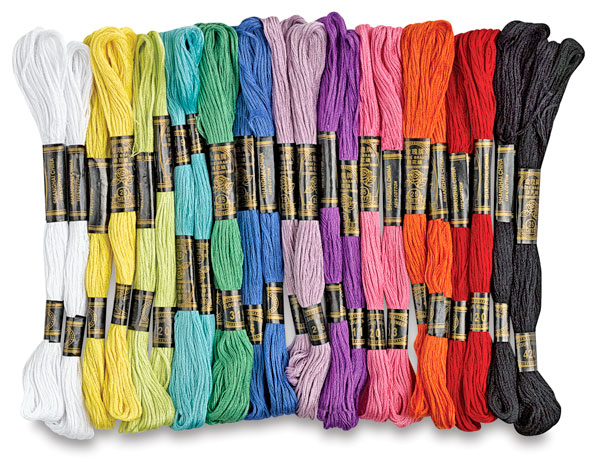
This is embroidery floss. Usually, you separate the strands into sets of two. Most embroidery patterns call for using two strands. You should not cut your floss too long as it will tangle while you are stitching. Again there are many manufacturers of the floss.
Here is a chart with needle sizes and pearl cotton sizes. As you can see, the size you choose will change the look of your stitches.
There are many, many embroidery stitches. Too many to list here, but there are several sources that you can get that list them all and give instruction as to how to make them.
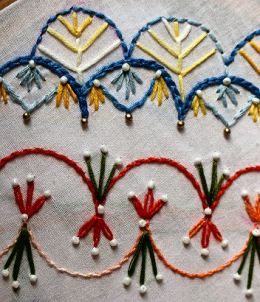
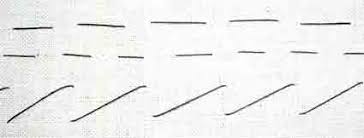
This is a sample of the most basic stitches. There are many online resources that you can obtain instruction for free.
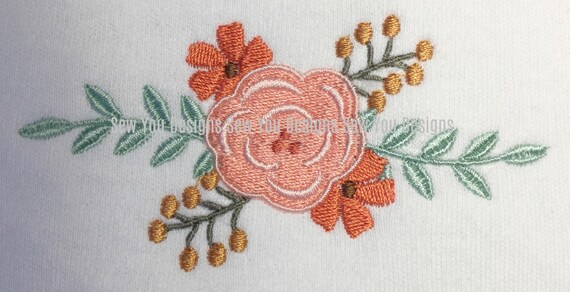
The last type of embroidery I want to mention is machine embroidery. This is fun to do especially if you have little ones around you sew for. I love to put little sayings and cute animals on my granddaughter’s tee shirts. It’s also nice to monogram with an embroidery machine. You can tell the difference between hand and machine embroidery. It’s just a matter if you like using a machine more than hand sewing.
When you are making an embroidery piece a hoop is used. There are many types of hoops on the market. Some are metal, some are wood, some are plastic some are round and some are square. There really isn’t any right hoop or wrong hoop. It’s what you are comfortable using.
I learned to embroider with a metal hoop. It was given to me in the 1950’s. I used it for a very long time. The only problem I see with using a metal hoop is that they do eventually lose their finish and can put marks on your piece. When that happened to my metal hoop I switched to a wooden one. Now I use plastic hoops. They make them now with a stop on the hoop so that you don’t push the hooped piece through the outer hoop.
When you are making an embroidery piece it is very important that when you are done stitching for the day you do not leave your needle in the fabric. if you have excess around your piece you can stick it through that area, but never leave it where the stitching is. If for some reason you don’t get back to that project for a long time, the needle can rust and stain your piece.
My mother had started a stamped tablecloth after she married my dad. She had done a small amount of the work and put it away. Years later after I was married it wound up with me. I opened it up and the needle had stained the tablecloth. I worked on that stain to see if I could get it out and I was unable to. I was able to stitch over it by adding a small branch into the design. I was lucky. Another project I had left a needle was ruined.
Embroidery is fun and relaxing. Projects work up quickly and you get better the more you do. If you like to have something to do when sitting in front of the TV, I suggest giving embroidery a try.
I have been exploring the origins of names of some quilt blocks that have been around for years. One of my favorite blocks is the Churn Dash.
The Churn Dash is one of the oldest 9-Patch quilt block patterns. It came about sometime between 1800 and 1849. The block got its name because it resembled the triangle and rectangle perimeter of the block to a butter churn and the center square to the stick or “dash” of the butter churn.
This was one of the first patterns that young girls learned. It’s simplicity of rectangles, triangles, and squares also provide a challenge for advanced quilters because it lends itself well to intricate designs.
A few years ago I participated in a block exchange. This was the block we used. I still haven’t put them together. I had actually forgotten about the blocks until today when I immediately thought about the churn dash after checking on the daily prompt.
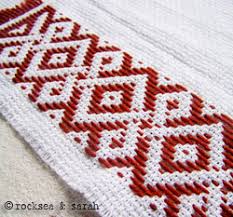
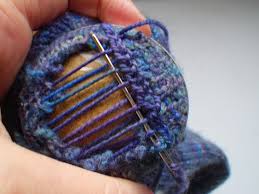
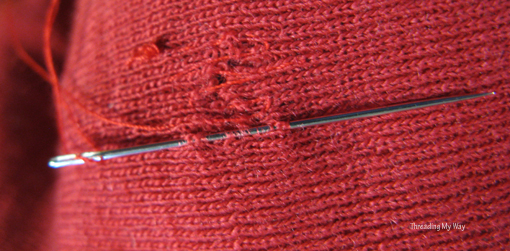
Darning is a sewing technique used to repair holes or worn areas on fabric. It can also be done on knitted and crocheted things too. Usually, it is done by hand, but can also be done by machine.
Darning consists of anchoring the thread in the fabric on the edge of the hole and carrying it across the gap. It is then anchored on the other side, usually with a running stitch or two. This is a simple over-and-under weaving of the threads.
Belgian darning, which is fine darning attempts to make the repair as invisible and neat as possible. Often the hole is cut into a square or the darning blends into the fabric.The use of fancy weaves, such as twills, chevrons, etc., is achieved by skipping threads in regular patterns.
Invisible darning is the epitome of this attempt at restoring the fabric to its original integrity. Threads from the original weaving are unraveled from a hem or seam and used to effect the repair. Invisible darning is appropriate for extremely expensive fabrics and items of apparel.
In machine darning, lines of machine running stitch are run back and forth across the hole, then the fabric is rotated and more lines run at right angles. This is a fast way to darn, but it cannot match the effects of fine darning
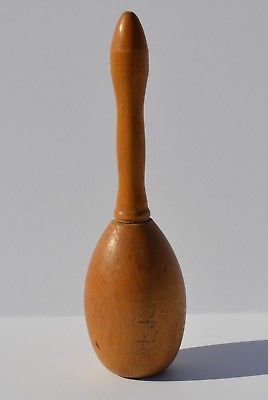
I learned to darn when I was quite young. I still have the darning egg that was my grandmother’s. It has proven to be very handy in repairing sweaters, hats, and scarfs for the kids over the years.
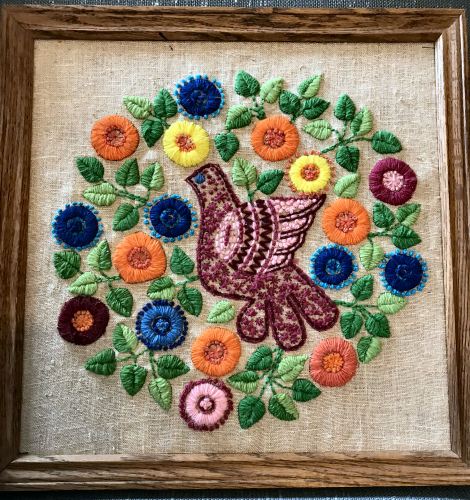
Crewelwork is a type of surface embroidery using wool. An outline of an image is put on a piece of fabric, then the areas are filled in with different types of embroidery stitches. This technique has been around for at least 1000 years.
I have made several crewel pieces over the years. The only one I still have is the first piece I ever did. My husband’s grandmother taught me how to do crewelwork after he and I were married. We were at a yard sale in Lancaster. As we were walking around, Nana found a kit to make a pillow or wall hanging. I think we paid 25 cents for it.
When we got back to her house, she showed me how to do the crewel. I really liked the effect that using the yarn made. Regular embroidery floss does not give the dimension that the yarn gives.
My granddaughter Alannah did a crewel piece for her mother a couple of years ago for Mother’s day. It is an easy project to teach young children since it works up fast and the stitches can be very basic.
Here is the wall hanging I made from that 25 cent kit we got at the yard sale.
I have always loved this piece. Not just because it was the first crewel piece I did, but because of the bright colors used.
It’s that time again for another one of Cee’s Share Your World. Here are her questions and my answers. 🙂
What was or is your favorite cartoon? I don’t know if I have a favorite cartoon. I guess that would include animated movies right? I would say, Finding Nemo.
Which cooking utensil (other than the usual pots and pans etc) would you miss the most?I would be totally lost without my instant pot. I cook on Sunday for the whole week and I use it every week. I make everything in it.
Would you dare to sleep in a haunted house overnight? No, I don’t believe I would want to invade the spirits territory.
What did you appreciate or what made you smile this past week? The beautiful weather! It has been warm, sunny and the Carolina Blue sky is as bright as can be. 🙂
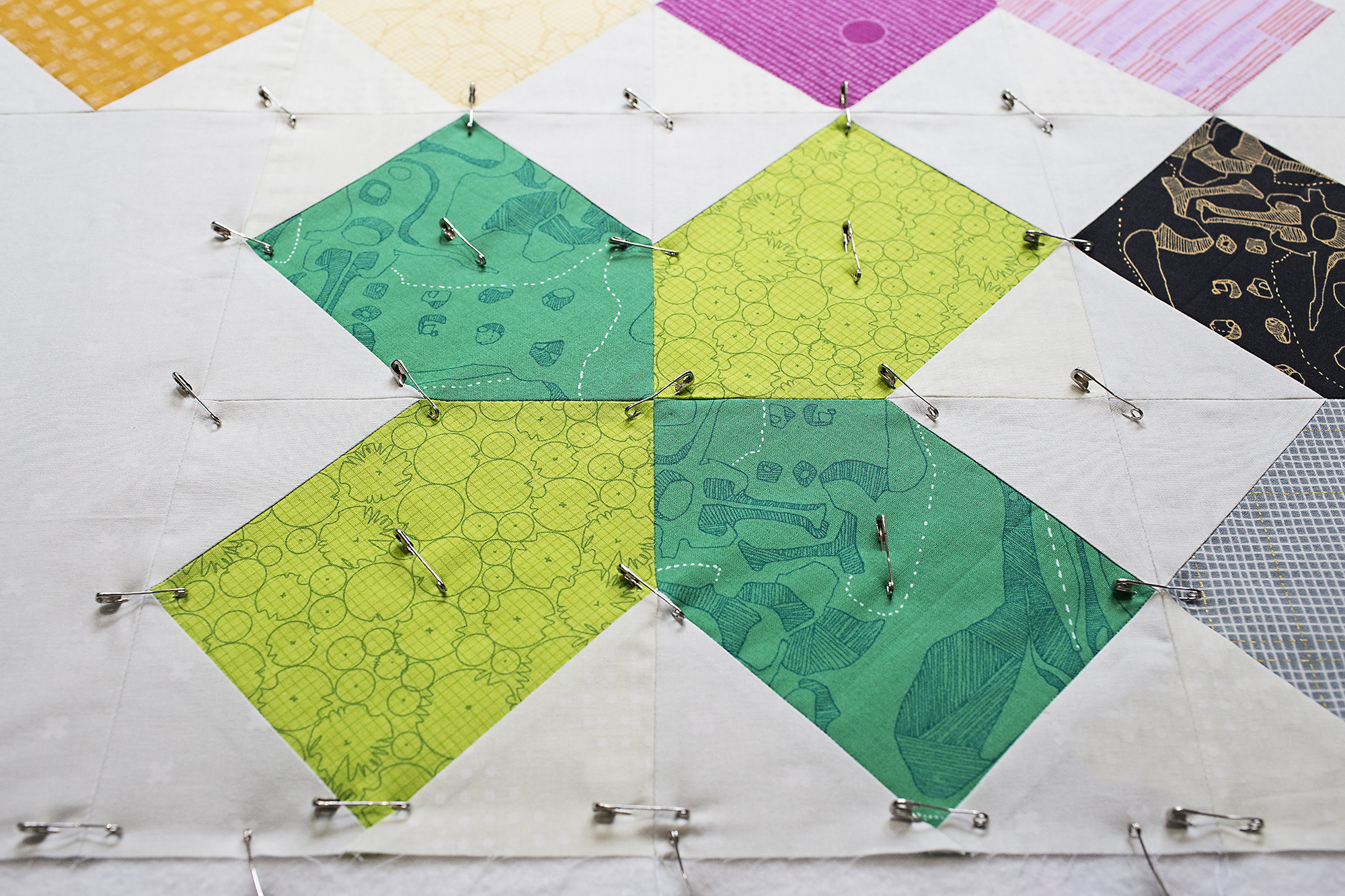
Basting is a term used for holding two pieces of fabric together prior to quilting or holding a zipper in place to keep it from moving while you sew it into a garment. Basting can be done by hand or machine. And in quilting also by safety pins. Usually, basting stitches are long stitches that are easily removed after the article is completed.
In quilting, when you put your sandwich together, the top, bat, and backing, safety pins are placed spaced about six inches apart so that you can make your quilting stitches.
Welcome to darradaily where you get information about my opinions on lifestyle topics with Nigerian peculiarities as my niche. I'll move away from my niche from time to time.
Don't forget to follow me for funny and educational contents✨.
To participate in the Ragtag Daily Prompt, create a Pingback to your post, or copy and paste the link to your post into the comments. And while you’re there, why not check out some of the other posts too!







:max_bytes(150000):strip_icc()/15Stitches-587161e53df78c17b6e270e8.jpg)
 The Churn Dash is one of the oldest 9-Patch quilt block patterns. It came about sometime between 1800 and 1849. The block got its name because it resembled the triangle and rectangle perimeter of the block to a butter churn and the center square to the stick or “dash” of the butter churn.


 Cookies & Moo